Leslie Groves
American PrometheusLeslie Groves was the Army general who transformed the bomb project into a fast-moving military enterprise and chose J. Robert Oppenheimer to direct its central laboratory. Their relationship rested on a useful paradox: Groves regarded Oppenheimer as essential and trusted his extraordinary ability, yet also saw the physicist’s political associations as leverage. The partnership helped make Los Alamos possible, while its bargain between scientific authority and military control shaped the security controversies that followed.
From Army Construction to the Manhattan Project
On September 17, 1942, General Brehon B. Somervell told Groves, a forty-six-year-old career officer, to abandon his hopes for an overseas combat assignment and remain in Washington to supervise the S-1 project. Groves had been a key Army Corps of Engineers figure in constructing the newly completed Pentagon. He was not impressed by the scientific undertaking at first: when it was mentioned, he answered, “Oh, that thing,” and observed that he was already spending far more on Army construction than the project’s anticipated $100 million budget. Somervell had decided, however, and Groves’s new assignment came with promotion to general.
On September 18, Groves formally took charge of the Manhattan Engineer District, generally known as the Manhattan Project. That day he arranged to purchase 1,200 tons of high-grade uranium ore; the following day he ordered the acquisition of a site at Oak Ridge, Tennessee, for uranium processing. Later in September he began visiting laboratories working on uranium isotope separation. These first moves display the scale and practical urgency he brought to the job: resources, sites, and research efforts were to be gathered into a coordinated undertaking.
Groves was described as nearly six feet tall and weighing more than 250 pounds, gruff, plainspoken, and impatient with diplomatic subtlety. He was an authoritarian by temperament and training, a conservative who scarcely concealed his contempt for the New Deal, and someone accustomed to getting others to do his bidding. Oppenheimer, though very different in manner and outlook, shared his capacity to influence people. Oppenheimer once characterized him as “a bastard, but he’s a straightforward one!” The contrast did not prevent cooperation; it helped define its terms. Groves could be abrasive, but his dealings were legible, and he had the authority to make decisions that determined whether the scientific project could proceed.
Choosing Oppenheimer and Building the Partnership
Groves met Oppenheimer at a Berkeley luncheon on October 8, 1942. Soon afterward he visited Oppenheimer’s office with Colonel Kenneth Nichols. Groves handed Nichols his Army jacket and ordered him to take it to a dry cleaner, a display of rank that astonished Robert Serber. The meeting also began Groves’s assessment of the physicist as a possible director of the proposed central laboratory. Oppenheimer understood that Groves controlled access to the project and responded with charm and intellectual fluency. Groves was struck by what he called Oppenheimer’s “overweening ambition,” which he thought could make him a dependable, perhaps pliable, partner. He also liked him and was impressed by the breadth of his knowledge. Oppenheimer’s proposal to place the laboratory in an isolated rural location suited Groves’s security concerns.
A week after they first met, Groves had Oppenheimer flown to Chicago, where the two continued their conversation aboard the Twentieth Century Limited to New York. Groves was already considering him for the directorship, despite three reservations: Oppenheimer had no Nobel Prize, had never had administrative experience, and had a political background Groves considered objectionable. The appointment was therefore not a simple recognition of conventional credentials. Groves judged that Oppenheimer’s ability and ambition outweighed those deficiencies, and that the laboratory’s needs called for a director capable of commanding fellow scientists.
The book presents their mutual calculations as central to the partnership. Groves believed Oppenheimer indispensable, but also thought his left-wing associations gave the Army a means of influence over him. Oppenheimer knew that his position depended on continuing to appear, by far, the best director available. He believed that demonstrating singular competence would persuade Groves to let him run the laboratory as he saw fit. Each man expected to shape the other: Groves through authority and security scrutiny, Oppenheimer through performance and scientific leadership. Their shared ambition was directed toward building a weapon intended to defeat fascism and win the war.
That arrangement was visible in the Army’s everyday relationship with the laboratory community. Groves privately called Los Alamos’s civilian scientists “the children,” and instructed a commander to keep living conditions and family problems from distracting them from their work. The civilians, for their part, often found him distasteful; he made clear that their opinion did not trouble him. His attitude subordinated domestic comfort and professional independence to the project’s demands, even as the Army had to maintain a community in which scientists and their families lived.
Security, Trust, and the Chevalier Affair
Groves’s support for Oppenheimer did not mean that he set security concerns aside. Lieutenant Colonel John Lansdale recommended retaining Oppenheimer as scientific director while drawing him into the security system. Boris Pash objected to this more subtle approach, but on July 20, 1943, Groves ordered that Oppenheimer receive a clearance “irrespective of the information which you have concerning Mr. Oppenheimer. He is absolutely essential to the project.” When Nichols informed Oppenheimer, he also warned him to avoid questionable friends and said that the Army would tail him whenever he left Los Alamos. The clearance was thus both an act of confidence in Oppenheimer’s value and a decision to keep him under surveillance.
The tension became personal in late 1943, when Groves ordered Oppenheimer to identify the intermediary connected to George C. Eltenton’s request for scientific information. Oppenheimer had committed himself to answer frankly if ordered. Reluctantly, he named Haakon Chevalier, while maintaining that his friend was harmless and innocent of espionage. Groves believed the investigation would not progress without names; Oppenheimer, meanwhile, had to reconcile his friendship with his promise to the general. Their relationship had made room for candid disclosure, but the demand exposed the cost of that candor.
Groves later described a more specific assurance: according to his account in 1953, he had promised Oppenheimer that a full disclosure would not become a formal report or reach the FBI. He then said Oppenheimer told him that Chevalier had approached Frank Oppenheimer and that Frank had asked Robert what to do. That recollection mattered because it suggested that Oppenheimer might have been protecting his brother, rather than simply withholding the name of a friend. But Groves himself could not remember exactly what Oppenheimer had told him in 1943–44; his 1953 account was shaped by what former assistants had told him about Frank’s connection to the affair.
Groves’s conduct toward the FBI had earlier demonstrated the strength of his loyalty to Oppenheimer. When agents asked about the affair in June 1946, he said he could not discuss what Oppenheimer had told him in strict confidence. Even after the agents identified Eltenton, Groves did not want them to confront him if that might lead back to Oppenheimer. Years later, however, the 1953 account brought Frank’s name into the record. During the security hearing, Roger Robb did not pursue Groves’s speculation about Frank or disclose the promise that Groves said he had made. Those omissions left the focus on Robert; the relevant FBI documents remained classified for twenty-five years.
The Bomb’s Deadline and the Test
Groves’s operational impatience pressed the project toward completion. As the planned use of the weapon approached, he favored speed over refinements that might delay availability. Oppenheimer recalled proposing design changes that would use material more efficiently, but Groves rejected them because they jeopardized prompt readiness. The timetable was tied to President Harry S. Truman’s planned meeting with Joseph Stalin and Winston Churchill at Potsdam in mid-July. Scientists working toward a date near August 10 understood that the schedule was fixed at great risk to money, development policy, and the people doing the technical work.
Groves initially opposed a full-scale implosion test because plutonium was scarce and he believed not an ounce should be wasted. Oppenheimer persuaded him that the test was essential because their knowledge remained incomplete. Without it, Oppenheimer argued, planning the weapon’s use over enemy territory would have to proceed substantially blindly. The episode shows Oppenheimer exercising influence within a command structure he did not control: Groves could insist on the timetable, but the scientific director could make the case that the project’s own practical objectives required a test.
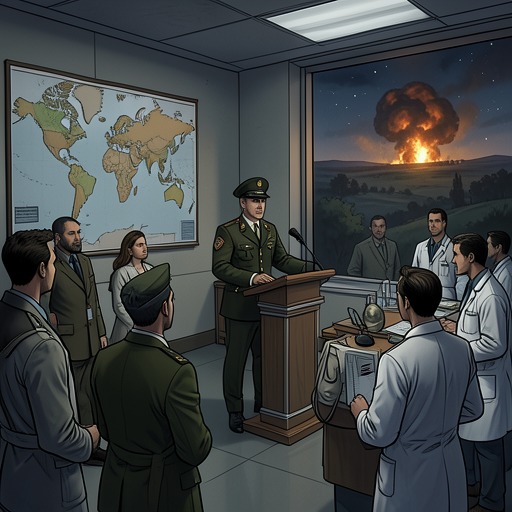
As the test approached, weather threatened the schedule. Oppenheimer’s chief meteorologist, Hubbard, expected the storm to pass before sunrise and recommended moving the detonation from 4:00 to 5:00 a.m. Groves, already agitated and distrustful of Hubbard’s judgment, opposed postponement. He took Oppenheimer aside to lay out the reasons to proceed; both men knew that a delay might mean waiting two or three days. Groves then brought Oppenheimer to the control center at South Shelter, 10,000 yards away, as a way to keep the decision from being changed by more cautious voices. Their partnership had reached a moment when scientific judgment, weather, exhaustion, and military scheduling converged in a single decision.
After the test, Groves called Oppenheimer from Washington at 2:00 p.m. on August 6. He told him, “I’m proud of you and all of your people.” The brief congratulation carried the force of a working relationship tested by years of pressure: the general who had chosen Oppenheimer now publicly recognized the laboratory’s achievement as a collective one. Yet the confidence between them did not erase their disagreements or the moral and political questions raised by the weapon they had built.
Wartime Loyalty and the Security Hearing
Groves’s political outlook also differed sharply from that of scientists who hoped for postwar openness. In 1954 he testified that, from roughly two weeks after taking charge of the project, he had regarded the Soviet Union as an enemy and conducted the program on that basis. His stance contrasted with the wartime hopes of scientists such as Niels Bohr, whose advocacy of international communication alarmed Groves. Groves had arranged for Bohr and his son to travel to Los Alamos under close supervision, personally accompanying them from Chicago with Richard Tolman. Tolman and Groves took turns watching Bohr on the train to prevent him from leaving the compartment; after an hour listening to the talkative physicist, Tolman told Groves he could not continue the watch. The episode shows how Groves understood security as physical containment as well as secrecy.
He also acted to contain a challenge from within the scientific community. When Oppenheimer informed him of Leo Szilard’s petition, he did so disparagingly. Groves’s aide raised the possibility of getting rid of Szilard, but Groves believed that firing or arresting him would provoke a revolt among the scientists. With Oppenheimer also annoyed by Szilard’s actions, Groves felt the matter could be contained until the bomb was ready. His response was practical rather than conciliatory: suppressing dissent carried its own risks, and the project’s unity had to be preserved until its immediate purpose was accomplished.
At Oppenheimer’s 1954 security hearing, Groves praised his wartime performance and said he would be amazed if Oppenheimer consciously committed a disloyal act. On the Chevalier affair, however, Groves admitted that the many versions had left him confused. He remembered an approach and believed Oppenheimer knew of it, but his testimony also emphasized his earlier understanding that Oppenheimer had been trying to disclose a danger to the project while protecting old friends, possibly including his brother. Under cross-examination, Groves maintained that granting Oppenheimer a clearance in 1943 had been the right judgment at the time, yet hesitated when asked whether he would clear him in the present. The hesitation marked the distance between the wartime decision—Oppenheimer was essential—and the later security standard applied to him.
Groves’s role in Oppenheimer’s story is therefore neither simply that of a military overseer nor that of an uncomplicated defender. He chose and protected a director whose political background he distrusted, used security scrutiny as a means of control, and kept faith with him when the FBI sought information. Later, he incorporated recollections that implicated Frank and could not offer a clear answer about whether the wartime clearance should still stand. The same traits—command, pragmatism, suspicion, and personal loyalty—could sustain Oppenheimer’s authority at Los Alamos and leave his case, years later, clouded by the very security system that had once admitted him.